-
Top 5 Horror Movies of the 1940s


The 1940s found America engaged in the business of war, and for four and a half years, business was good. Then in 1945, all of the active service men came home and everyone was expected to pick up where they left off, before they had seen the atrocities of war. Most of the horror movies during this decade were produced by Universal, who had a growing stable of now-classic movie monsters to menace earnest young women, when they weren’t engaging in their own turf wars for supremacy.
The modern world was rapidly intruding on the gothic sensibilities of the previous decade’s horror movies, so Universal obligingly dropped the monsters into a more contemporary setting. Apart from the change of scenery, the monsters still grappled with their inner demons. What the 1940s horror movies seemed to be most preoccupied with was keeping it together. This would have real and fictional repercussions a decade later.

The optimistic propaganda of early wartime America was quickly subsumed in the aftermath of the atomic bomb drops that signaled the end of World War II and would soon usher in the Atomic Age and the Cold War in equal parts.
(more…) -
Top 5 Horror Movies of the 1930s


This is the decade where movies officially came into their own, narratively speaking, with the advent of sound, and horror movies were right there from the beginning. In fact, the studio that became synonymous with horror, Universal, produced a whole slate of horrific features whose creatures were so impactful that they remain recognizable icons nearly a hundred years later.
Universal was carrying on the tradition of ghastly sights on the silver screen that started in the 1920s during the silent era; Lon Chaney and his grotesqueries were not far from the public’s minds, and many of the silent stars transitioned over to the talkies and continued to thrill audiences. Horror came into its own as a new kind of spectacle that only movies could deliver at the time. Now that sound was possible, the audiences could not only see the sepulchral crypt, but they could also hear the chains rattle, the coffin lid creak open, and the helpless young women in gossamer, diaphanous white gowns could all scream.
Within reason, that is. In the middle of 1934, the Hays Code was enacted, Hollywood’s first attempt at self-regulation of their content. “Pre-Code” movies sometimes showed bare breasts (artfully, mind you) or other “shocking” scenes that were deemed grotesque and unsettling. And while there certainly some movies that benefitted from a lack of restraint, several movies listed below were made after the Hays Code was adopted and their impact was not diminished in the slightest. Most of these movies would also have a place on the cult classics list, and it’s that combination of transgressive and outré that sets them apart from other films of the decade.
The thirties were fueled by the Great Depression, providing a relatively inexpensive escape from reality of the bread lines and doing without. Science and scientific progress are hallmarks of the era, as magazines like Popular Science and Popular Mechanics routinely featured experimental vehicles and buildings on their covers. It’s also noteworthy as the decade where Hitler rose to power overseas, producing an undercurrent of unease that wouldn’t fully be understood by the population at large until America entered World War II.
(more…) -
Finn’s Top 5 Horror Movie Lists: Introduction


I started writing these Top 5 lists for horror films ten years ago, mostly because I was sick and tired of how so-called “experts” and “critics” were reviewing and critiquing horror movies online. It drives me crazy that we are thirty years into Internet culture, effectively spending forty hours a week online and inside of social media—a second job’s worth of time, and people still don’t understand how to communicate with it. This technology that has democratized free speech has also reduced it to its most rudimentary form.Anyone online can be “an expert,” or a “media critic.” Anyone can write an opinion and angle it as a collection of facts. There’s no test for anyone to take in order to see if they understand the basics of rhetoric, debate, constructing a persuasive argument, writing to and for a specific audience, etc. It’s still the wild west in terms of digital content creation, and that’s not likely to change anytime soon.
So, just in case you don’t know me, and you’re wondering why I’m so strident about this, or maybe you’re thinking, “Where the hell does he get off…?” Here’s my bona fides:
(more…) -
Tools of the Trade, now in book form!
Hmm? What’s that? Oh, nothing, just this new tabletop role-playing game supplement I wrote. It’s now available in book form.

All papery and shiny and ready to roll! You can grab yourself a copy of it right here: Tools of the Trade: A GM’s Guide to Creating and Running Fantasy Heists. The paperback is $16.95 and the pdf is $10. Or, if you like, you can roll on over to the Ogre’s 11 Kickstarter, in progress as part of ZineQuest 4, and add Tools of the Trade as part of your reward for backing (and if you do that, you get both the book and the pdf for one price). If you want to get your caper on before the Dungeons & Dragons: Honor Among Thieves movie hits next year, then you need this book.
-
Nerd Alert! A New RPG Book for Fantasy Heists!

Sound the whoop whoop! There’s a new book on the horizon! It’s called Tools of the Trade: A GM’s Guide to Creating and Running Fantasy Heists, and if that sounds cool to you, then you’re who I wrote this for!
The book is still being approved for printing, but the pdf is available right now at DriveThruRPG.com at this link right here: Tools of the Trade. What’s it about? I’m so glad you asked.
Tools of the Trade lets you create a random, interesting and challenging caper or heist in just minutes. It’s fast, robust, and easy to use. Just a few dice rolls, a few details you supply and viola! A heist! A very palpable, palpable heist. There’s over a 120 pages of useful info, guidance, and ideas for you to pull from.

A sample page layout, showing tables from the Contact Creator This pdf retails for $10 and the book will retail for $16.95, but for this weekend only: From Now until Sunday, July 17th, I’m offering the pdf of Tools of the Trade free to anyone who subscribes to the North Texas Apocalypse Bunker newsletter at the paid level, or who joins my Patreon at any level! That’s right, it’s a signing bonus!
My Substack: https://ntab.substack.com/
My Patreon: https://www.patreon.com/northtexasapocalypsebunker
Join me on either platform for $5 and you’ll get the PDF! (Note: The Newsletter on Substack is free and always will be. You don’t have to join at the paid level, and hey, now that you’re thinking about it, go take 30 seconds out of your day and subscribe for free, if nothing else! You can stay looped in on the personal highs and lows of everyone here at the N.T.A.B. and check out the occasional dog photos, too. -
Field Report: Cross Plains, Texas, June 10-12
Robert E. Howard Days is an annual event that takes place just as the heat trends to nigh-unbearable in Texas. It’s also in a part of Texas that requires a car and a map to get there. This means that you have to want to come out for a visit. You fly into Dallas or Austin and rent a car (or hitch a ride with a fellow pilgrim) and make the two or three hour trek into the central part of Texas. It’s in Cross Plains where you first meet the various members of Project Pride, who have taken charge of the Robert E. Howard house and museum (on the National Registry of Historic Places, and now, a Texas Historical Marker unto itself). You tour the house, and you get to stand in the doorway of the room where Robert E. Howard wrote his stories and it’s moving. It’s really moving. People approach the room with reverence, and they are not disappointed.
It’s also in Cross Plains during Howard Days where you will meet fellow travelers, luminaries, and other assorted professional writers, artists, editors, and Big Name Fans for the first time, and you quickly learn that there are no barriers between the Guest of Honor and yourself, nor any of the other program participants. All through the weekend, in any of the sites and settings, between all of the panels and readings, you and the other fans are talking about Our Favorite Author with enthusiasm, and if you are one of those people for whom REH is your obsession and yours alone, getting to plug into an event like this is singular and unforgettable. Very few people, if any, ever go away from a Howard Days gathering underwhelmed, or feeling as if it weren’t worth the effort to go. Most people make plans to return.
Twelve miles separate Rising Star from Cross Plains on Highway 36, and yet, there are mile marker signs at regular intervals, like Burma Shave ads, and this beauty two miles outside the city limits. This is my second home away from home. I go every year, to reconnect, recharge. It’s like a really cool family reunion. It’s been rough the last five years, for all of the reasons you probably know about, and a few you don’t. But this year? This was the best gathering in a long time.
Over the years, I’ve brought conservatively 50 or more people to Cross Plains; I’ve been going since 1997, and I’ve been active in REHUPA since 2002–twenty years, with only two or three years missed due to things like family tragedy, surgery recovery, and so forth. This year was a stellar effort. In addition to Janice, who would get the full-on three day experience, she inveigled seven other members of her family to drive in, see the sights, experience the magic of Howard Days. I mean, the only other year where I outdid that number of guests was 2006, the Centennial Year, when I brought in an entire radio troupe from Austin.

In my DM uniform. You know, just in case you weren’t sure who the geek was… We drove in on Thursday, a logistical necessity, since I’d hit the ground running Friday morning. I was to moderate a panel and then run a special Dungeons & Dragons game for some lucky attendees (the theme of this years’ gathering was “REH and his Influence on Gaming”) that was built using my forthcoming rules for creating heists and capers in D&D and based on the classic Conan story, “The Tower of the Elephant.” After that, it was time for the banquet, where Guest of Honor Fred Malmberg would speak, and then, at 9 PM, Chris Gruber and myself would host “Fists at the Ice House,” a perennial favorite, where we’d talk about Howard’s love of boxing, his boxing stories, and we’d read excerpts from some of our favorite REH boxing stories. We’ve been doing this panel for fifteen years or so, and not only do some folks come to it every year without fail, but there’s always at least one person who walks up to us afterward, eyes wide, and says, “I…I…I had no idea he could be funny!” We just smile at them, and say, “Welcome,” and then they go and buy one or more of the boxing collections and we have another fan for life.

We had to move the banquet from the community center to the gym at the Baptist church, and we filled that room to capacity, too. I was a bit worried about having everyone from Janice’s family on hand. I mean, it’s one thing to bring me home for Christmas, and it’s quite another to have them drive out from Waco and drop feet first into the hardcore nucleus of Robert E. Howard fandom. Who knew what they’d see? I couldn’t be there to translate.
As it happened, I needn’t have worried. Everyone grokked pretty quickly the importance of REH as a Texas writer, something he doesn’t always get credit for because people are too busy trying to peer around Conan’s broad shoulders to see what’s behind them. They also just had a cracking good time meeting the folks in Cross Plains, visiting the other sites in town, like the library and Woody’s classic car museum, and going to the open house at the local newspaper and getting the tour, making friends, etc. They all ended up on the front cover of the newspaper.
I’ve never made the paper! They got in on the first try! This was also Janice’s trial by fire, because a lot of people were going to meet her for the first time and they were going to have opinions about her, me, us, and all the rest of it. Now, I wasn’t worried about Janice not getting along with anyone; she’s very personable and has never met a stranger. But that constant pressure, all the hugging, etc. can be a bit overwhelming.
Again, I needn’t have worried. Her uncle on her mother’s side even stayed to watch the D&D game I ran. They had a blast overall and I fully expect to see most of them back next year. The ones that don’t return will be replaced by friends they’ve managed to entice with their beguiling descriptions of friendly folks, literary shenanigans, and a top-notch Dairy Queen.
I didn’t need to put a cover on my adventure notes, but I can’t help it sometimes. Also, I really like this image from the Steven Fabian Portfolio about The Tower of the Elephant. 
Photo courtesy of Jeb Boyt, who couldn’t play in the game because he was running his own at the library. But he snagged this pic of me in DM Mode. The Friday panel was an overview of the history of Howard’s properties in various games, starting way back at the beginning of tabletop role-playing, on through the modern day, where we have rpgs, board games, computer games, card games, and they are all imbued with a reverence and a fidelity to the source material that has been really refreshing to see. I moderated the panel, and even though there were six of us: Fred Malmberg, Bill “Indy” Cavalier, Jason Ray Carney, Funcom’s creative director Joel Bylos, and Monolith’s Matt John, I think we accorded ourselves quite well. Jason thoughtfully put together a PowerPoint presentation with images of all of the extant games, and we were able to key off of his slides and talk about some cool games, past and present.
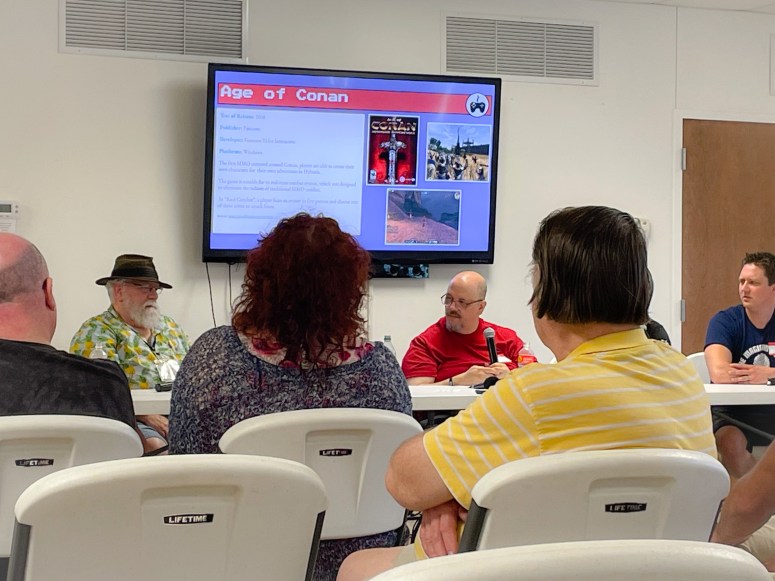
Audience members are obscuring Fred Malmberg, Jason Ray Carney, and Joel Bylos, but this is a great picture of Indy, Matt John and myself. The D&D game went over pretty well, I think. No one rage-quit, flipped the table, or threw dice at me. The adventure was a kind of sequel to “The Tower of the Elephant” where the party was hired to retrieve the special rope poor Taurus used in his ill-fated assault on the tower with Conan. I loved writing it, and I think I’m going to make it an official Polite Society playtest adventure.
Since I was gaming, I didn’t get to see the presentation of the REH Foundation Awards, but thankfully, you can get the rundown here.The banquet was great; the food was really delicious, and on time, which is always a plus. But everyone was blown away by the Silent Auction, which was crammed to the gills with all kinds of great loot this year. All of the proceeds go back into Project Pride’s coffers to help keep the Howard House in good repair, offset expenses, and so forth. I wish I’d thought to get a picture of the room, with stuff on every table and people hovering over the books and prints like vultures. But I didn’t.

Me and Grub at the Ice House. We look like we’re about to start some shit. This is my most favorite picture of us at the Ice House ever. Janice took this, along with most of the other pictures with me in them. I’m glad she was here, or there wouldn’t have been ANY pics. This year’s Ice House panel was a blast. We always end up with about 30 people or so, all sitting or standing on the concrete slab that marks the remnants of the place where Howard used to blow off steam on Friday nights, boxing and roughhousing with his buddies. Later, that hands-on experience would find its way into a body of work that’s roughly three times the size of his Conan output in titles, if not word count. Adding the funny westerns in, all told, about one-third of Howard’s total output is told in a southwestern tall lying vernacular that is unlike anything else he wrote. We showcase that during our readings, and it always goes over big. Grub was in fine form this year, having missed the last few get-togethers. I was just happy to have a wingman.

It’s not sexy, but hallowed ground is hallowed ground. This was the part of the trip that Janice’s family got the most out of, I think. It’s one thing to have your daughter always bragging on her boyfriend/fiancée, and it’s quite another to see him in his element, in action. I was happy I got to perform for them, but I may have overdone it; they are already talking about me doing a reading for the family during Christmas…
Saturday’s panels were were a lot of fun. Paul M. Sammon returned to talk about the 40th anniversary of the 1982 sword and sorcery classic, Conan the Barbarian. Paul worked in publicity in L.A. at the time and got to cover the film extensively. He’s got a lot of great unseen and rare photos, and also a lot of funny behind-the-scenes stories. He’s a great storyteller himself, and the panel was more like an extended conversation with him.
I moderated another panel about adapting REH’s works to games, and it was kind of a repeat of the Friday panel, but a bit more technical in execution. We had a ball talking about what we did and how we did it, but Joel Bylos batted clean up on the panel when he broke out his gaming rig and treated us to about twenty-five minutes of a game Funcom was working on and then shelved for capricious reasons. It was a first person rpg Conan game, and it adapted the actual stories into adventures. He wowed everyone with “The Tower of the Elephant” (a weirdly-recurring theme throughout the weekend), showing Conan walking in the Maul in Zamora, talking to people about Yara and his tower, and then we got to meet Taurus in the walls of the tower’s gardens…voiced in the game by John Rhys-Davies! Yeah! Gimli! Sallah! I mean… I may have sworn directly into the mic when I realized who it was.
Saturday wrapped up with the final panel of the day, called “What’s Going On with REH?” and it’s a run-down of projects on the horizon or that just dropped. We then adjourned to the pavilion by the house, ate barbecue, and then the porchlight poetry session started. Open mic, reading Howard’s poems aloud, including “Cimmeria,” translated this year into Italian, Japanese, Gaelic, Norwegian, German, and French, and read by those same native speakers in attendance. If that sounds cool to you, it is. It’s way cooler than people think it will be.
Folks stayed at the pavilion, talking, drinking, and talking some more, until well past midnight. No one wants to call it and go home. That’s the power of our little family reunion. Our crazy little Relax-A-Con, our working vacation that we always overcommit to every year, and then do it again as soon as we’ve recovered.

Me and Jeb Boyt at the pavilion. My God, we are Man-Pretty. That’s Howard Days, in a nutshell. Bobby Derie hands out free books; he’s been doing it for years, now. Ben Friberg brings home-made ice cream for folks. Everyone brings regional beverages from exotic places like Kentucky and Canada. We sign each other’s books, and take pictures with one another. Freebies abound, from upcoming projects to specific tchotchkes that tie into the yearly theme. The REH Foundation Press is on hand with books to buy, so you can see what they look like before you commit, and the gift shop is always full of loot and swag, including some rarities that always make people’s jaws drop.
One of the REH Foundation Press stalwarts, Stale Gismervik, brought his whole family in from Norway and they spent two weeks in Texas, driving around and seeing everything they could. Stale is an exceptional photographer, and he took a shit-ton of much better photos that have to be seen to be believed. You can go to his online magazine The World of Robert E. Howard and join and look at all of his photo albums; it’s so worth it.
And if Stale’s photos of Cross Plains, the Texas countryside, and the goings on at Howard Days, don’t motivate you to finally pull the trigger and plan on going next year, well, pardner, I reckon you ain’t never gonna. -
From the Vault: In Defense of Bad Movies, Part 2 – FLAAAASSSHH!


Check out the muscles on Blonde Conan! In Part 1 of In Defense of Bad Movies, I outlined the disconnect between film critics and the general public. If you want to read it, you can certainly do that. Now that I have made this particular bed, I’m going to lie in it by taking a pipe wrench to the skull of a film most beloved and personal to the Geek Nation. Let’s all watch some people’s heads explode. Fun!
Since I mentioned Flash Gordon (1980) in Part 1 as an example of a bad movie, I thought it would be worthwhile to explain why I think this is so. Before you start typing your hate mail, there’s some objective criteria below that you ought to look at. I put pictures in the post, so you wouldn’t have to just take my word for it. If you make it all the way to the end and still feel triggered, feel free to leave a comment. I’m bracing myself for impact. Okay, enough of that; let’s go tip some sacred cows!

“Gordon’s Alive?!” Flash Gordon is a bad movie. It was bad in 1980 and it has not aged well. It’s not a bad movie for what it gave us, a campy, over-the-top spectacle of outdated special effects and a plot that’s actually worse than the cliffhanger serials starring Buster Crabbe (and this is subjective—lots of people like it for that very same reason), rather, it’s a bad movie because it rendered a 45-year-old pop culture icon largely unrecognizable for no other reason than it could. Maybe it’s not fair to compare it to the very recent idea that a movie should reflect more of the source material than not; I mean, we are talking about the 1980s, when everyone still smoked cigarettes and didn’t know no better, and one of the best movies of 1980 was Kubrick’s The Shining, which did the same thing—jettisoned huge chunks of the book and replaced it with Stanley Kubrick’s sensibility. His “take” on the novel. So, why does The Shining get a pass and Flash Gordon does not?

Brilliant. Terrifying. And irreverent with the source material to the point of being dismissive. It’s simple: Kubrick’s The Shining is nearly universally loved by both Kubrick fans and horror movie fans and is universally considered a great movie, despite being a genre film, from a noted auteur. The film fits within his overall catalog of movies as a stepping stone from 2001: A Space Odyssey (1968) and Barry Lyndon (1975) up to Full Metal Jacket (1987), in professional growth and artistic development. Contrast this with Flash Gordon, which opened to mixed, confused reviews. Some people really liked the high camp that was intentionally shoehorned into the movie. Others thought the high camp didn’t work and stated reasons. What every review did agree on was that the movie was jokey and hokey and played for laughs and felt intentionally cheap in some places. Not everyone liked the Queen soundtrack, either.
So, there you have it. The movie is campy and cheap. The mattes and optical composites look like bad chroma-key on Channel Eleven’s 10 PM Weather Report, circa 1979. The dialogue is clunky, and sometimes that’s funny and sometimes it’s not. Flash’s “sword” looks more like a hockey stick, and he doesn’t really ever use it. Aside from the general look of Ming the Merciless, the movie bears no resemblance to the thing that’s been in the public eye for forty-five years prior.
That said, I kinda still like the movie. Not all the time; I have to be in a specifically nostalgic mood to watch it, and even then, I don’t usually make it all the way through. My eleven-year-old self thought this movie was amazing. But then again, my eleven-year-old self hadn’t read any of the Alex Raymond Flash Gordon strips at that time, either. Shortly after first seeing Flash Gordon, I tracked down the Buster Crabbe serials. Watching them only added to my confusion.

This is Alex Raymond’s Flash Gordon from a Sunday strip dated Aug 14, 1938. Raymond was an artist’s artist, and he is still studied and appreciated by comic creators to this day. I didn’t understand what “camp” was, not really. The movie was less campy that the Batman TV series, but the football fight scene in Ming’s throne room—with Dale acting as a cheerleader—was ludicrous. The music makes it fun, but it’s a far cry from a duel with swords, like what we see in that famous Alex Raymond panel in the comic strip.
Years later, when I got my hands on the Flash Gordon comic strip reprints, I became righteously indignant. The disconnect between the original stories and the over-saturated, intentionally camp 1980 movie is equal to roughly the distance from Earth to Mongo. It soured me on the film, and I couldn’t watch it for a long, long time after.
Still, it’s not as if I wasn’t warned. Here’s a news item from Fangoria #8 (Oct 1980), incidentally the first issue of Fangoria I ever bought:
FLASH GORDON: Flash or Trash? That’s the question on the lips of everyone concerned about the fate of Alex Raymond’s comic strip soap opera now that its cinematic fate is in the hands of Dino De Laurentiis. The screenplay is by Lorenzo Semple Jr., whose best- known work to date is the De Laurentiis King Kong screenplay, preceded by the Batman TV scripts. As for effects, we’ve heard from one source that they are said to be excellent—and from another that outmoded effects techniques are being used, with shoddy results that perfectly complement the “low-camp” approach of the screenplay…De Laurentiis seems anxious to become the Hollywood Czar of science fiction—he’s already bought into Dune and Conan, and has recently been waving stacks of money under Ilya Salkind’s nose in an attempt to buy into Superman III. If anyone brings the current boom period for fantasy film to a premature end, it will be shortsighted producers who underestimate the public taste. Whether good or bad, Flash Gordon just might be a portent of Things to Come.
In hindsight, Fangoria was right on the money with its prognostications in the last two sentences. Regardless, the critical reception when Flash Gordon first premiered was mixed. To succinctly illustrate this point, here are Gene Siskel and Roger Ebert talking about Flash Gordon. Pay attention to Roger Ebert’s comments:
Ebert: …I’m fond of it. I don’t think it’s great. I just sort of like it.
Siskel: What I object to is [it’s as] if you’re rewarding a film that doesn’t try hard, for not trying harder.
Ebert: Aw, now, well, you just miss all of the fun when you talk like that.
Ebert closes out the program by calling Flash Gordon “…A tacky extravaganza that’s dumb but entertaining.” Here’s the whole episode if you’re curious.
The thing is this: they both agree that the movie is bad. Ebert, who wrote Beyond the Valley of the Dolls (1970), itself a cult classic, understood the intrinsic value of bad movies. I don’t think Siskel ever did. Ebert forgives it, because he kinda likes it as a separate thing unto itself. Siskel doesn’t forgive it and considers it to be both overblown and mediocre at the same time. That pretty much sums up the two prevailing opinions about this movie. And this is from 1980. There’s been a disconnect about this movie all along, in that it does not deliver what the movie title promises.

Another Sunday strip from Raymond dated June 12 1936. Not even his best stuff, and yet this artwork leaps off the page. Check out that
gorgeous action sequence in panels 4 and 5. Incredible stuff.Simply put, the only Alex Raymond content in the movie is found in the opening credits montage, in those amazing panels taken from the legendary comic strip, paired with Queen’s histrionic theme song for the movie—a soundtrack that most certainly contributed to the film’s nascent success and subsequent cult classic status. The rest of the movie, on the surface, is ludicrous, high camp. To an eleven year old just discovering all of the vast history of science fiction in print and other media, this film was a Charm’s Blo-Pop. It was fun, and Brian Blessed nearly steals the movie in his Falstaffian portrayal of Prince Vultan, and Ming’s daughter was hotter than Georgia Asphalt, and Ming himself was simply insane, for Pete’s sake, his whole reason for attacking the Earth is “Why Not?” and when War Rocket Ajax’s spire impales Ming at the end of the movie, you know what you just watched was not Star Wars, and it sure as shit wasn’t Empire Strikes Back, but you didn’t have anything else to compare it to, so yeah, it was fun and crazy and weird, and to an eleven year old seeing all of this for the first time with no critical faculties developed, that’s enough. What was there to compare it to? Battle Beyond the Stars? Seriously.
Watching Flash Gordon now, I am often sent down memory lane to where I was and what I was doing at age eleven and twelve and, if I’m in the right frame of mind, I find I can still like some parts of the movie. But it’s a bad movie. It’s part of my reminiscences of growing up, and it’s very hard to untangle the movie from my memory of the movie. Nostalgia spackles over many of the faults in this film, and it’s powerful glue, because it’s so personal and so tied to precious childhood memories. But nostalgia can’t change the fact that the movie was badly made.
On the Flash Gordon Wikipedia page, there is an interesting, if not revealing, section under the Production heading called “Development.” It’s worth a look:
Initially, producer De Laurentiis wanted Italian director Federico Fellini to direct the picture; although Fellini optioned the Flash Gordon rights from De Laurentiis, he never made the film. George Lucas attempted to make a Flash Gordon film in the 1970s; unable to acquire the rights from De Laurentiis, Lucas decided to create Star Wars instead. De Laurentiis then hired Nicolas Roeg to make the film. Roeg, an admirer of the original Alex Raymond comic strips, spent a year in pre-production work. However, De Laurentiis was unhappy with Roeg's treatment of Flash Gordon, and Roeg left the project. De Laurentiis also considered hiring Sergio Leone to direct the Flash Gordon film; Leone refused, because he believed the script was not faithful to the original Raymond comic strips. De Laurentiis then hired Mike Hodges to direct.
Lorenzo Semple, Jr. wrote the script. He later recalled:
 Dino wanted to make Flash Gordon humorous. At the time, I thought that was a possible way to go, but, in hindsight, I realize it was a terrible mistake. We kept fiddling around with the script, trying to decide whether to be funny or realistic. That was a catastrophic thing to do, with so much money involved... I never thought the character of Flash in the script was particularly good. But there was no pressure to make it any better. Dino had a vision of a comic-strip character treated in a comic style. That was silly, because Flash Gordon was never intended to be funny. The entire film got way out of control.
In other words, Flash Gordon fans and appreciators of Alex Raymond’s comic strips didn’t want to write the movie that Dino wanted. When one of them wrote it anyway, Dino didn’t like it. He kept looking until he found the guy most responsible for doing camp super heroes and tongue-in-cheek movies, and he got him to write the script. But even Semple, Jr. didn’t like what the movie became after he was done with it, because it strayed so far from the source material.

This concept art looks awesome. And it was used to sell the movie to foreign markets. I’ll bet they were pissed off when the movie came out! Talk about a Bait and Switch… What Flash Gordon has become, quite by accident, is a cult classic. The Queen soundtrack, the over the top performances, and the whack-job dialogue are all cited by fans as to what makes it great. It’s enjoyable to watch because for a generation, it’s a reminder of when we did not have an embarrassment of riches like we do now. It’s impossible to untangle Flash Gordon from pleasant memories, laughing at it with friends, or hearing it referenced in other popular culture; even repeating the quotes to friends to get a laugh all contribute to the idea that the movie is a kind of cultural touchstone for fantasy and science fiction and comic book fans. Despite it being a bad movie, or perhaps because it completely is, Flash Gordon is rightfully a cult classic. But it’s not a good movie. People watch Flash Gordon now for the same reason that people used to watch Barbarella (1968) in the 1980s.
There’s an old Jewish expression: if three people tell you you’re drunk, go lie down. Dino’s reply to that practical advice, apparently, is to get everyone else drunk, so he doesn’t look so bad in comparison. Dino sure knew about making movies. He made enough of them, and if you go back and look at the movies in The Movies of Dungeons and Dragons series, you’ll find his family’s name on many of them. They all have swords and have people riding on horseback. So, if he wanted to make a Flash Gordon movie, and base it on Alex Raymond’s character, either in print or from the serials, he could have easily done that, especially with the technology available in 1980. But he didn’t want to make Flash Gordon. He wanted to re-make Star Wars, only differently. His way. Like the Batman TV show. If we’re being completely honest, George Lucas only made Star Wars because he couldn’t get the rights to make Flash Gordon!

Filmation Studios, with limited animation and a fraction of
Dino’s money, got ten times closer to a recognizable version
of Flash Gordan than the 1980 movie.
Hokey and cheap? Maybe. But still more sincerely attempted than de Laurentiis’ 1980 movie. De Laurentiis was a schlockmeister, a monied boor with zero impulse control. He didn’t have the taste in his mouth that God gave a turkey vulture, much less a person with critical faculties and an education in filmmaking. Quick aside: he fought with people throughout the production of Conan the Barbarian and King Kong, as well. People tried to tell him not to do certain things, because those things were stupid and awful and bad, and he never listened to them. In the end, he made exactly the movies he wanted to make.
Liking Flash Gordon does not make you a flawed human being. Calling Flash Gordon your favorite science fiction film of all time, and in the same breath wondering why so many people think Blade Runner is so great makes you a terrible film critic, because the instrumentation you use to measure a film’s worth is not calibrated correctly. In the grand scheme of things, that’s not even a venal sin; I’m a terrible basketball player and I sleep just fine at night. I think accepting that Flash Gordon is bad—not faithful to the source material, badly produced, and needlessly campy—and still thinking that the movie is okay, or something you like to watch once a year, can and should be a compatible thing. I think that there are a lot of film critics who will add years to their life if they will do that one simple thing.

A gorgeous poster. Also, a giant lie. Maybe you don’t feel that way; fans as a rule tend to be uncritical of the things they love. Maybe there are other movies that you vehemently defend when people mention how bad they are. Everyone’s critical faculties are wired differently. As an adult, you should be able to look at the criteria by which a person is making a judgement call and take that into consideration. If there are measurable reasons, to which your answer for them is “Yeah, but still…” then they have a point and that’s worth acknowledging, if not completely considering. If their reasoning boils down to, “It just sucks, okay? It just does. How can you think it doesn’t?” then that’s an uncritical response and you can safely ignore it.
You may not want to examine your preferences in such detail. Maybe you just want to like what you like and damn the torpedoes. If that’s the case, then you need to expect someone online occasionally calling one of your favorite movies garbage. Movies that really, truly divide the room critically are few and far between. You’ll either been in the majority or the minority when it comes to movies, and especially genre movies, and most of the time, you’ll know it, too.
No matter what, you need to own your choices, and not apologize for liking what you like, even if (and perhaps especially if) it’s a bad movie.
-
From the Vault: In Defense of Bad Movies, Part 1 – Somewhere Between High Art and Cult Classic

I write a lot about old movies. I like writing about film; I have been a professional reviewer and critic for many years now, and I’ve been named one of the top movie reviewers in Texas by the Associated Press Managing Editors several times. You may also know that I am co-owner of a movie theater in North Texas that plays first-run movies on two screens, which is kind of like a unicorn in today’s market.
I love talking about movies, both what they mean on the surface and what they are not saying deep beneath the crust. Talking about film is one of my favorite things to do. I also read a lot of film history books and try to keep up with the popular scholarship surrounding film studies. I’m not as deep in that as I would like—these past few years have made it difficult—but I consider it more than a hobby for me, and slightly less than an avocation. When I do write about movies (and other popular culture), I have three different approaches that I use:

Fannish
This is usually an unapologetic gush, or a rush of “How cool was this?” moments. I don’t use it too often, but it does come up from time to time, especially when we’re talking about films that I love despite having a pretty nuanced yardstick. Dinosaur movies. Movies with gorillas in them. Any movie with pirates. My biases and predilections are on the record so there’s no real need to re-hash them here. That’s not to say I can’t be critical of these movies, but I usually don’t, because I like to give my brain a rest with old friends.

Critical
There may well be complimentary things in this tone of voice, because I often use a Good/Bad/Ugly structure, but I actively seek to get underneath what’s onscreen and talk about why a film works or doesn’t work, or sometimes, what is says, or doesn’t say. This tone, or something very like it, is what most professional reviewers use when they trash Venom and praise The English Patient. My essays about film are usually in this style and tone, because I think this is the sweet spot between Fannish and Scholarly. Also, it’s a lot less work in that sometimes they will write themselves.

Scholarly
This style is what I use when I’ve got a thesis to present and I am making a case for it. If you had to write a research paper in high school or college, you know what I mean. Sometimes, my tone is casual, and sometimes, my presentation is haphazard (because, having presented papers at academic conferences before, doing it in MLA style is a pain the ass), but I have a point and I’m going to walk you through it.
My long-running Finn’s Top 5 entries strike a chord somewhere between Fannish and Critical, and The Movies of Dungeons and Dragons comes in somewhere between Critical and Scholarly. The Top 5 lists are subjective, and even though I state my criteria up front, the list is modified by other lists, and also how closely the movie cleaves to the subject. That’s just how my brain works.
With The Movies of Dungeons and Dragons, I have a specific intention that filters my commentary: how impactful were these movies on First Edition Old School Dungeons and Dragons players? Specifically, me and my extended groups of friends and fellow gamers? That’s a terribly specific and hyper-focused lens to use, but that’s okay, because in scholarship, it’s not uncommon to look at a creative work from only one angle or to judge it by a narrow criteria.
My film writings have always generated lively discussion between me and my friends. But there’s always one or two people who become indignant or offended or just incredulous that I didn’t like A, or loved B, or didn’t mention C, or they think I’m just plain wrong about D. Granted, this is all subjective, because my trash may be your treasure, and vice versa, and I think that’s well established.
It’s important to remember that even amidst all of the subjective opinions about movies, there are some measurable data points. I’m talking about bad movies, and more specifically, the ability to identify and acknowledge that a movie is bad, and also having the wherewithal to like it anyway. I think it’s perfectly okay to like bad movies; God knows, I like plenty of them—entire genres and sub-genres of movies, in fact. But I know they are bad. I accept that they are bad. You can love an ugly dog, too. In fact, sometimes, you can love an ugly dog way more than you love a Kennel Club champion.
I’ve gotten tired of the hipsters and film school dropouts who litter the Internet like spilled Legos in a daycare center that have weaponized sarcasm and irony so that they can employ the “It’s so bad, it’s good” defense. This allows them to chatter excitedly like squirrels about, just to pick a movie out of a hat, Flash Gordon (1980), and still maintain their “street cred.”

If you’ve done your job correctly, a reader should be able to tell within three or four paragraphs of your writing, approximately 250 – 300 words, if you’re knowledgeable about your subject. And if you’re writing a 1,000 word piece on the merits of Flash Gordon as the alpha and the omega of bad science fiction, then your readers should not get to the end of the article and think, “What is this asshole talking about?” or worse, “That son-of-a-bitch, he just threw Flash Gordon under the bus, man!” I’m not saying that every online critic is bad at their job, but…well…okay…I guess what I’m saying is that the vast majority of the self-styled “online critics” are exactly that. And while we’re at it, probably 65% of all the print media film critics are not that great, either.
There’s something about being made the sole film critic for the East Haverbrook Picayne-Journal that turns some people into blithering imbeciles. Something about taking that job makes them think they are tastemakers for the whole of East Haverbrook (and the new West Haverbrook development, where all the real landed gentry have flocked to) and start championing Sony Picture Classics films and pooh-poohing genre movies, when the biggest box office success story last year at the East Haverbrook Cineplex was the remake of Stephen King’s IT. I agree, that sentence sounds bizarre in the modern world, but you know what? That’s all the more reason to discuss it. Why did something that had three strikes against it—a remake, a Stephen King property, and a horror movie released in September—suddenly become one of the biggest hits of the year? That’s worth exploring, regardless of genre.
But film critics tend to downplay anything that elicits a visceral response other than all-consuming sadness or crushing ennui. Don’t believe me? Go look up the reviews for Stephen King’s IT (2017) and watch how every second paragraph begins with some version of, “But even with all that going for it, the film is still…” and then there’s criticism about the pacing, or the sameness of the scenes, or that Pennywise becomes a cartoon after a while, or this, or that, or insert some film terminology here and there to signal to your readers, “See? I wasn’t really scared, you guys.” I’ll bet every single one of you a million dollars that there will be at least one major news outlet that runs a story in 2019, after IT: Chapter 2 premieres in September, with the headline, “Does IT: Chapter 2 Forecast the Beginning of Horror Movie Fatigue?”
Simply put, these people have forgotten who they are writing for. A good reviewer can explain a movie to an audience and communicate what’s good about it, what’s bad about it, and whether or not that audience should spend their dough on it, and they can do it while (a) not giving the plot away, (b) letting the audience know if the movie is objectively good or bad, and (c) let the audience know if the reviewer liked it despite (or because of) its flaws. That seems like a tall order, but it’s really not.
A good film critic is someone you can read and readily ascertain what they value in a film. If they are consistent, you can even read a review about a movie they don’t like and from their writing, decide if you will like it and make an informed decision. That’s the job of a good reviewer; not to condescend or to impress the reader with how much they know, but to use that knowledge to inform the reader about what they have seen. There are many print journalists who are good at this. There are not a lot of Digi-Critics who are. But when you go onto sites like Rotten Tomatoes, you don’t get to pick which critics you want to hear from. They lump everyone in together in an aggregate, and so that’s why there’s almost always a disparity between what critics think about movies, and especially genre films, and what fans think about movies.

However, having said all of this, let it be known that genre movies can be, and frequently are, bad. Badly conceived, badly written, badly acted, badly directed, badly produced, you name it. This is a lesser concern in 2018, but throughout the rich history of the cinema, i.e. most of the twentieth century, bad movies are legion. And that’s okay. Not everything can be Citizen Kane. Or Gone With the Wind. Or Casablanca. It’s why those films are considered classics; the cream rises to the top. Great movies withstand the test of time, whilst bad movies simply go away…unless rescued by a group of passionate fans who see something more in a movie, or maybe it speaks directly to this sub-group, or it becomes greater than the sum of its parts. You know what I’m talking about: the “cult classic.”
The best example of this is The Rocky Horror Picture Show (1975). Without the yelling and the audience participation, the movie is pretty awful—but it’s nearly impossible for people to look at that movie now in any kind of critical vacuum. It has completely transcended its original intent: that of a film adaptation of a stage play that champions as well as subverts B-movies, in particular science fiction B-movies of the 1950s and 1960s. No one watches The Rocky Horror Picture Show to examine Richard O’Brien’s commentary on the movies of his youth. Cult classic.
In Part 2 of this essay, I’m going to take apart a beloved cult classic to show that a bad movie can still be a good thing.
-
From the Vault: The Movies of Dungeons & Dragons, Part 5 – the End of an Era

Sword and Sorcery became an exploitation genre, rife with quickie production schedules, recycled sets, props and costumes, and written-on-the-fly scripts that checked boxes for mandatory story elements. The only bronze-thewed barbarian that managed to escape such a fate was, inexplicably, Beastmaster, which made not one, but two sequels and then morphed into a syndicated television series that lasted more than one season. Unbelievable.
Meanwhile, over at the first-run theaters, where the floors were slightly less sticky, an attempt was being made to both cash in on the epic fantasy genre and also elevate it somewhat. The results were decidedly mixed, to say the least. That’s not to say that these movies weren’t good, or that they weren’t an integral part of growing up in the 1980s, but these movie swing far and away from the Robert E. Howardian gothic horror sensibility that informed Conan (and E. Gary Gygax), and the Vancian magic of the Dying Earth stories, and even the darker corners of Tolkien’s Middle Earth. We’re now in some version of the real world, more fairy tale—but not fey—than Epic Fantasy or High Fantasy.

Pretty obvious who the stars of the movie are, right? No love for Hauer. Ladyhawke (1985)
This Richard Donner-directed fantasy-romance was a twenty million dollar example of the fix being in. We don’t need all of that sword-and-sorcery nonsense! We’ve got Rutger Hauer! Still skinny, too! We’ve got Michelle Pfeiffer, who is never not ever been every adolescent male’s wish-fulfillment fantasy woman. We’ve got Matthew Broderick, hot off of Wargames (1983) and in full-on cheeky smart-arse mode (big hand-waving hint, here: he’s who we are meant to identify with, ‘cause he’s like us, see?).
This movie is quite watchable, provided you can make it through the jarring soundtrack, which is mired in its 1980s-ness, to the point that it was written by Andrew Powell and produced by Alan Parsons. This is a major stumbling block for me. According to the Wikipedia page for this movie:
The film’s score was composed by Andrew Powell and produced by Alan Parsons. Richard Donner stated that he was listening to The Alan Parsons Project (on which Powell collaborated) while scouting for locations, and became unable to separate his visual ideas from the music. Powell combined traditional orchestral music and Gregorian chants with contemporary progressive rock-infused material. It has been cited[who?] as the most memorable example of the growing trend among 1980s fantasy films of abandoning the lush orchestral scores of composers such as John Williams and James Horner in favor of a modern pop/rock sound.
I’ll let you decide, after reading the above, who to blame or credit for how much you love or hate the soundtrack. Since this my article, I will hoist myself on this petard and state, for the record, that whatever the merits of prog-rock, and there are certainly many, heavy synth-pop-infused techno beats have no place—whatsoever—in historical/fantasy/period-based movies, unless that period-based movie is set in 1985. Or, to put it another way, this soundtrack blows. I like Alan Parsons, but he was the wrong fit for this film. He just was. And I don’t care that Andrew Powell was involved and used Gregorian chants—all of that is undercut when the electronic drums and the Moog synth kick in over them. That’s Parsons’ decision—as the producer and “musical director” of the soundtrack. You know what? I’m going to blame Dick Donner for this. He’s the one that drove over the countryside scouting locations, blasting “Eye in the Sky”. Have some taste, man!
This movie goes the way of many films in the 1980s and 1990s; the desire to make a period production and also appeal to modern audiences. No one really seems to be from another time, not in hair nor in makeup, not in manner of speaking nor in acting. The sole exception Rutger Hauer, who is honestly great in this movie, one of his few turns as a hero. Pfeiffer is charming and pretty, but this isn’t her best work. What she has is good screen chemistry with Matthew Broderick, who is struck by her beauty (and this we believe). Leo McKern is also great as Imperius, a drunken old monk who helps and fits in the Friar Tuck role quite easily. But historical accuracy? Pish Posh, my good man. We’ve got a double-sided crossbow for the captain of the guard! And a claymore!
If you can ignore the soundtrack—a herculean feat, to be sure—is much to like about Ladyhawke, perhaps moreso as an adult in 2018 than as a teenager in 1985. The arms and armor are a mishmash of styles, chosen because they look cool, and, well, isn’t that most of our players’ reasoning in Dungeons and Dragons in the first place? The “Fairy Tale” elements are at odds with the clearly modern production, but it’s not unenjoyable, if you park it right next to A Knight’s Tale (2001), which is certainly this movie’s spiritual successor. If nothing else, you can skip to the final battle, a lengthy, exhausting swordfight, with horses, no less, reminiscent of Boorman’s Excalibur that takes place in a church. Sufficiently epic, and also the best example of a critical failure for an attack ever put on film. Watch when Marquet, unseated from his horse, inexplicably hurls his helmet at Navarre, only to have the throw wildly miss and smash the big-ass stained glass window some forty feet above them. Huh. The sun’s out. I wonder if that’ll be relevant in about five minutes?
For those of you who feel that I’ve maligned great art, here’s Rob Hunter’s spirited defense of the movie, including the soundtrack. Some of you will squee with delight at his assertions. Granted, he still wrong, but let it never be said that I’m not fair in my assessments.

Dog-Dragons? Labra-dragons? Draga-doodles? Nope. Just Nope. The NeverEnding Story (1986)
I’m a sophomore in high school, and so I understand if some of you who were maybe 6 or 7 years old have a weird affection for this deranged piece of cinematic fluff—but all of you who are my age? Older? What’s your excuse?
I watched this movie with my arms crossed, feeling like I was being talked down to, and worse, this whole movie is a metaphor for combatting depression and reality by, I dunno, wishing for a different outcome? I scoffed at the movie in my teenage years, and I really scoff at it now.
This hugely expensive film drops most of its budget on the best mid-range animatronic rigs a film could buy at the time, but that’s still not saying a whole lot—it’s like being the prettiest gorilla at the zoo. All of the money was spent making these huge animatronic creatures for the kid to interact with, but it still looks like the world’s best Chuck E. Cheese birthday jamboree. Every servo is constantly in motion as the mouth opens and closes and the spot in the middle of the upper lip twitches to and fro, and the dubbed voice is saying really complicated things that are coming out of a puppet’s mouth. I couldn’t finish it. The whole thing was a terrible distraction.
Jules Feiffer noted in his introduction to The Great Comic Book Heroes (1965):
“I couldn’t stand boy companions. If the theory behind Robin the Boy Wonder, Roy the Superboy, The Sandman’s Sandy, The Shield’s Rusty, The Human Torch’s Toro, The Green Arrow’s Speedy was to give young readers a character with whom to identify it failed miserably in my case. The super grownups were the ones I identified with. They were versions of me in the future. There was still time to prepare. But Robin the Boy Wonder was my own age. One need only look at him to see he could fight better, swing from a rope better, play ball better, eat better, and live better-for while I lived in the east Bronx, Robin lived in a mansion, and while I was trying, somehow, to please my mother-and getting it all wrong-Robin was rescuing Batman and getting gold medals…”
I didn’t read this quote until I was a senior in high school, but it cogently articulated how I felt about boy heroes in movies, whether it was the Goonies, or Short Round, or any kid in any Steven Spielberg movie for that matter, and most certainly including the kid in The NeverEnding Story. I didn’t want to be Atreyu and I never did. I wanted to be Conan, or Tarzan, or failing a simian education and endurance training on the Wheel of Pain, maybe Grey Mouser. That little shit? Forget it. I was too old. That ship had sailed. Maybe for people who were seven or eight in 1985, this film was relevant, but not for me. I didn’t care that Fantasia was being consumed by Ennui (how terribly German) and what does it say that the author of the book, Michael Ende, apparently beloved in some corners of the world, was so incensed by the movie that he tried suing the producers to have his name taken off of the film? Wow.
The NeverEnding Story, despite a lackluster performance at the box office, was all part of this indiscriminate shift away from heroic fantasy and sword and sorcery into the realm of fairy tales—not high fantasy, or even epic fantasy (well, not yet). Simply put, if Hollywood was going to spend all this money on a movie, it wanted to cast as wide a net as possible. Fairy tales had romance, and were ostensibly something you could take a child to. These movies were safer bets than another Conan story, which on the surface looked like bloody sword fights and naked women. Back then, people still cared about the difference between a PG rating (or the newly-minted PG-13) and an R rating.
I resent having ever watched this movie.

That’s an awful lot of Muppets in the background, there. Labyrinth (1986)
As The Muppet Show was winding down on television, the Jim Henson studio was transitioning into movies using the Muppet technology to create fantastic creatures that didn’t look or move like anything else. This is how we got The Dark Crystal (1982), a movie about elves—I mean, Gelflings, and their quest to end up being Adam and Eve. As much as I liked the Skeksis designs in the movie, when Kira sprouted wings and Jen says, “Wings? I don’t have wings.” And Kira replies, “Of course not. You’re a boy.” I was done with the movie. Still, it was a complete world, brought to life, and in a storybook fashion, with far greater technical acumen than many of its contemporaries.
I think it was inevitable that the follow up to The Dark Crystal would be Labyrinth, a more traditional take on the classic baby-snatching changelings and fairy folk of old—the goblins in the movie, which of course, do not resemble the Dungeons and Dragons goblins in any way, shape, or form.

At least the Brian Froud poster art was awfully pretty. I did not care for The Dark Crystal, but I know a lot of people my age did. And while I certainly cared a great deal about Jennifer Connolly, I really didn’t like Labyrinth, either. That I can understand, though: if you like cute things, like babies, and goblins that look like Muppets, and David Bowie, then this is your jam. I think it’s a better, more accessible movie than The Dark Crystal, but it was clear to me that I was not the intended demographic for these movies. Simply put, I do not have the same reaction to David Bowie in a teased-to-the-rafters wig and rock-video-medieval garb holding a baby and singing to it that many women my age do. This movie hastens ovulation for a lot of its fanbase, every time they watch it, but not me. I appreciate Brian Froud’s gorgeous designs—and maybe Pathfinder’s silly and stupid goblins got their start here…who knows? In most of the scenes with goblins, I was reminded of Jabba’s throne room and Salacious B. Crumb.
What I did like was Jennifer Connolly, and the M.C. Escher staircase scene in the heart of the labyrinth. Is that it? Yes, I’m afraid. I know, my heart is cold and dead. I’ve watched the movie a few times since, and nothing ever changes for me. The Muppet performers are fantastic, but at no time do I ever buy that the humans are talking to living things. That alone makes it very hard for me to take any of the movie seriously. When the goblins sing, they all sound exactly like the Muppets from TV.
Labyrinth wears its influences on its sleeve, which is incredible since there were over twenty versions of the script written by a widely diverse array of writers that included Producer George Lucas. The Bowie songs pale in comparison to the songs on Let’s Dance, but when you consider that this movie is about girls transitioning into women, Bowie in the movie makes perfect sense.

Hey, Look! Bend bars/Lift Gates! Princess Bride (1987)
Finally. Something we all agree on.
When this movie hit, it was clearly lightning in a bottle. An eclectic cast; Andre the Giant? Cary Elwes? Wallace Shawn? Mandy Patinkin? Billy Crystal? Chris Sarandon? Christopher Guest? What kind of crazy movie is this? I could list them all and there wouldn’t be a pattern, except maybe in the choice of Rob Reiner as director, selecting people he’d previously worked with. It doesn’t matter, really, because they all coalesce into a once-in-a-lifetime storybook romance, literally being read to young Fred Savage by an avuncular Peter Falk, with perfectly timed asides when the kissing shows up, as well as righteous indignation at the notion the villain might escape his just comeuppance.
This movie is comfort food to my generation, both familiar and eternally new, as we catch something we never noticed before or hear a joke in a new way with each repeated viewing. There are monsters of a decidedly gamer-y nature: the Shrieking eels? The Rodents of unusual size? As well as locations like the Cliffs of Insanity and the Fire Swamp. I do not believe for one second that this was a shout-out to the D&D players in the audience, but rather William Goldman tapping brilliantly into the nomenclature of such stories that D&D borrowed for some of its set pieces.
The movie also involves political intrigue, albeit really simplistic, but it was enough to get us thinking. It was also refreshing to have the fair maiden in the story be a mere political prop instead of the universal object of desire for every man in the movie. In fact, only one man really has the hots for her; everyone else is pursuing their own agendas. This never overwhelms the story, but somehow manages to tighten it up.
The Princess Bride is one of the greatest romance movies of all time; it manages to be exciting without being an action movie, funny without being a comedy, and upbeat in the face of heartbreak, war, and death. It skirts the edge of absurd and never quite swings over into camp. All that’s left is an affectionate tribute to the swashbuckling movies of yore, some of the most quoted lines of dialogue in the history of movies, and that glorious, fantastic swordfight.

This poster advertising the VHS release of the movie is better than the original one sheet. Masters of the Universe (1987)
The phenomenon known as Mattel’s runaway toy line turned runaway hit cartoon, The Masters of the Universe, was at the end of its run with this movie, a Golan-Globus-produced epic that may or may not have helped put a nail in the Cannon Film Group’s coffin. Dolph Lundgren played He-Man, the muscle-bound hero—hey, he’s a quantum leap above Miles O’Keefe—and Frank Langella played Skeletor as an actual villain and not as comic relief.
And speaking of comic, or rather cartoons, well, let’s just say there’s not a lot of blood and guts in the film version of Masters of the Universe.
There was an assumption, I guess, that everyone coming to the movie would already know everything there was to know about He-Man, Teela, Man-at-Arms, and Skeletor and Eternia. That’s why they sent He-Man to…Earth? You know what, I don’t know what they were thinking and neither does anyone else. David Goddard allegedly remarked that his intention was to hide a lot of Jack Kirby’s Fourth World into the story, and if that’s the case, he failed miserably.
This is light fare, especially for so late in the decade, and seems to be torn about being a movie based on a kid’s cartoon and toy line and being a movie unto itself. The world was competently realized, and the special effects were perfectly adequate. The make-ups and costumes were okay. The movie is just…there, really. It’s shame too, because William Stout did the conceptual art for the movie and what he came up with is fantastic. The budget just didn’t allow for all of it. Hell, the budget didn’t allow for the movie we ended up with.
For people younger than me—my brother, for example, seven years my junior—this is the sweet spot for the late 1980s. Not so for me. My film noir phase was a few years away, as well as a critical survey of Elvis movies. I was deep into horror movies at this point. There’s just nothing in Masters of the Universe for me, then and now, and I suspect that even if you were running a science-fantasy (ugh) game, this movie would not be what you took your inspiration from. The movie isn’t bad enough to be bad, and it’s sure not good enough to be good. It simply is a thing that happened in the 1980s, like Corey Feldman’s career.

What an ugly poster. I’m surprised that this is what they went with. Willow (1988)
This could’a should’a would’a been a saving grace for fantasy films. It had the largest budget of any of the movies that had come before it. It had the mighty ILM special effects studio running point, and at a time when computers were starting to help out with certain optical effects—Morphing, it was called; that seamless transition from tiger to human. Big names, like Val Kilmer and, well, Val Kilmer. Nothing against Warwick Davis but, unless you were a Star Wars fan, you had no idea who he was. It had sword fights, and actual sorcery in play, not just glowing effects or luminescent tennis balls in a snowstorm. It had a story by George Lucas. Ron Howard was the director. This could’a should’a would’a been a course correction.
But it was not. And it did not. It’s kinda hard to take George Lucas at his word as to the particulars of when he got an idea and how and why he developed it; instead, let’s talk about what this movie is, even though we all know it anyway: It’s the Star Wars story, by way of Campbell’s monomyth, pushed through Tolkien’s Lord of the Rings like Play-Doh extruding from a Fun Factory.
In many ways, this movie was the fitting finale to the fantasy films of the decade, an effects-laden extravaganza with George Lucas’ name attached, ILM in the house, to better show us all how it’s done, Ron Howard (with George Lucas over his shoulder) directing, and a large cast running and leaping and chasing and fighting and morphing and kissing and hugging and casting spells and and and…
I will not insult your intelligence by pointing out the obvious and overt similarities to Star Wars, with a nice origin story from the Old Testament, complete with a baby basket ride down the river. Instead I will opine that I liked it better when it was Star Wars. The Lord of the Rings elements didn’t help matters much, either. When the hobbits—I mean the Nelwyn are tasked with taking the One Ring—I mean the baby to Mount Doom—I mean, the Daikini Crossroads, I was offended. Did Lucas not think that we read books? Because we do. And filing the serial numbers off of these Campbellian myth concepts didn’t render them unrecognizable.
Simply put, because of the regurgitated set pieces and plot points, I was never really surprised by the movie. I would have preferred that the movie stay in Hobbiton—I mean, the Nelwyn village. There was at least some drama I cared about in those characters. The kids were adorable. Willow’s wife was amazing. And the village felt like a real place. What few surprises the movie held for me were entirely superficial in nature; the monsters, for instance, the Death Dogs, the two-headed dragon, and even the furry ape-men trolls, held my attention better than the main plot of the movie. Oh, and the two brownies? Yeah, with the comical French accents? By the end of the movie, I was ready to go on a murder-spree. So painful, so annoying, so hackneyed and cliché, so stupid!
The movie looks nice, thanks to ILM and all of their work. Ron Howard juggled all of the components and got good performances out of the supporting characters. Had this been my first rodeo, I probably would have loved it unconditionally. But with everything that had come before it, the quest narrative and the bumbling sorcerer, and all of the other trappings, made for a been-there, done-that kind of experience. I think Willow was to the Fantasy film genre what Silverado was to the Western genre. As for D&D? It was nothing new, either. We had all of that stuff, already named, detailed, and in some cases, far more interesting. This movie broke no new ground.
The thing that all of these movies have in common? Disappointing box office returns. They were all universally expensive to make, and they didn’t do as well as expected, or at all, until cable and the VHS (and later DVD) markets allowed them to find their audience. Time and nostalgia play a heavy part in that, as well. As the 1980s trundled to a close, Reagan left office under a cloud of scandal from the Iran-Contra hearings and the Iron Curtain came down shortly thereafter. Batman premiered in 1989 and was the blockbuster that everyone was looking for, and the movie industry pivoted away from fantasy. Peter Jackson’s ambitious Lord of the Rings trilogy was twelve years away. Dungeons and Dragons likewise moved into its second edition, codifying and streamlining the various tomes that had been published in the decade. Demons were banished, along with Half-Orcs and Assassins, in favor of a kinder, gentler role-playing game.
The Age of THAC0 was upon us.
Missed something? Check out Part 1, Part 2, Part 3, and Part 4 here. Feel free to drop me a comment and let me know what I got wrong, or what I got so, so right.
-
From the Vault: The Movies of Dungeons & Dragons, Part 4 – The Best of the Rest

There were, in the middle of all this epic swordplay, a handful of near misses and one-offs, as well as a couple of Science-Fantasy “epics” that seemed more like an attempt to pander to the Star Wars crowd as well as offer up mediocre swordplay and derring-do in the form of bad jump kicks. Hollywood wasn’t interested in making the next fantasy blockbuster; they were obsessed with remaking that last fantasy blockbuster, only much cheaper than before. We ended up renting these at the video stores because, come on, no one saw this in the theater. How on Earth could we have? They were rated R for nudity, and/or they were shown at the drive-in (we had no car at the time), and so we had to wait until they made it to VHS or HBO. Or both.
Thankfully, my parents owned and operated a video rental store throughout my high school years, which was great for me, since I was allowed to advise as to the movies we stocked in the horror and science fiction sections. This made me the go-to guy for staying caught up on the latest nerd-films, from cult classics like The Adventures of Buckaroo Banzai to the magnum opuses listed below. What they provided for us gamers, more than anything, was laughs—hoots of derision or just knowing, rueful chuckles. After all, we had seen better films, hadn’t we? Maybe we weren’t the most discerning of audiences, but we did have some taste, right?

What a horrible piece of shit. I know there’s probably one or two of you out there right now saying to yourself, very smugly, “That fool! Three installments in and he forgot all about Yor, Hunter from the Future from 1983 starring Reb Brown!” No. No I did not. There are dumb movies. There are great movies. There are dumb movies that go all the way around the dial until they are inexplicably great again. And then there are movies that don’t even deserve to be on that dial in the first place. That’s where Yor goes, him and his appalling theme song. There is no metric by which this movie can be measured that would mark it as anything other than a waste of good 35mm film. Craft services had to make sandwiches for this movie to be made. Someone ought to sue. Instead, like the Czech Judge’s Figure Skating Scores at the Winter Olympics, we’re going to drop the lowest one so as to preserve a better statistical average. The movies below (even Hawk the Slayer) look exponentially better as a result.
“The Tale of Sir Lancelot” is my favorite Vignette in this movie. “Well, I got A note…” Monty Python and the Holy Grail (1975)
Granted, this movie wasn’t made in the 1980s, and it’s not at all sword and sorcery, but thanks to the VCR revolution, it was available for repeat viewings whenever we wanted to watch it, and watch it, we did, over and over and over again. I’m dropping it on the “so bad that it’s good” list because it has to go somewhere. Why, you ask? I’ll tell you: there was no other movie more influential to the hobby of tabletop gaming.
No film responsible for more quotes, both in character and out-of-game, as Monty Python and the Holy Grail. Try to think of another movie so ubiquitous that you can utter a single line of dialogue to a group of strangers at a convention and not only receive the next line of dialogue in return, but get it as a chorus, complete with horrible British accents. I once sang out, in a game room at a convention, “Pie Lesu Domine…” and watched as six or seven people, not at the same table, stood up and chanted back, “Dona Eis Requiem,” and then hit themselves in the face with their game books, notebooks, and in one case, his DM’s clipboard. That doesn’t happen with any other movie.
Holy Grail does not get the proper credit as a major contributing influence to the emerging culture of tabletop gaming. It is, perhaps the most important movie of all time in that regard. Granted, it’s also responsible for the proliferation of people who love to lapse into an English, or worse, an Irish or Scottish accent, break into the song about “Knights of the Round Table,” or just torture everyone around them by repeating the most strident lines of dialogue with the outright worst comic timing and delivery ever attempted by humans anywhere.
On the plus side, there is a lot of social value to breaking the tension, sometimes as a serious moment in the game, when things look dire, and your fighter is absorbing the damage that other characters aren’t taking so that they can cast spells, pick locks, or what have you, and the DM rolls damage…”the sword grazes you for 2 points,” and your fighter says, chest puffed up, “Tis but a scratch!” He gets the laugh, and everyone remembers that, yeah, it’s still just a game. From Tim the Enchanter to the Killer Bunny, from the Guardian of the Bridge to the Tale of Brave Sir Robin, Monty Python and the Holy Grail made it okay to laugh at the game table, and moreover, it showed us how.

Original poster art. What a fantastic lie. Hawk the Slayer (1980)
This “fan favorite” and “cult classic” may be the only one of these movies to deserve that appellation. John Terry plays Hawk, the much younger brother of Voltan (and can we just pause for a minute to reflect on the damage done to these two by their parents? Who names their kids “Hawk” and “Voltan?”), who is played by Jack Palance. Ordinarily, he’d be the guy who is out-acting everyone, but not here. And it’s sure not John Terry, who has been much better in other movies and TV shows, but in this film, he acts like he’s reading Ikea instructions to his drunk brother-in-law who is trying to build a Flurken Chair without an Allen wrench.
The best actor award is a tie between Bernard Bresslaw and Peter O’Farrell–the “giant” and the “dwarf.” Their banter and chemistry is practically the glue that holds this think-piece together. Other minor but celebrated actors and actresses (Patricia Quinn? Magenta from The Rocky Horror Picture Show? Anyone? Anyone?) round out the cast of this British Made-for-TV movie that got a limited theatrical release before being shunted into VHS and Betamax for the remainder of the 1980s. It’s important to take note of the fact that this was (A) British and (B) made for TV, because it explains why the special effects look like they were made by the A/V club and Seventy-five dollars. The single best use of a special effect is the re-purposing of the Kryptonian Prison Bands from the opening of Superman (1978) into a serviceable dimension door. That probably cost someone a week’s worth of food.
The plot is ludicrous. The acting is wooden. The motivation is ridiculous—Voltan instigates the “final confrontation” with his brother over a ransom of two thousand gold pieces? Forget the fate of the kingdom, the prophesy, the special secret magic that only Hawk knows—spoiler alert: it’s a sword that leaps into Hawk’s hand—forget all of that. Hawk’s special ladyfriend burned Voltan’s eye while he was trying to have his way with her, and so he’s taking it out on everyone. This world is a land full of assholes, and Hawk is the good guy because he’s the least-assholy-asshole of the bunch. His friends, the “elf” and the “giant” and the “dwarf” are merely the skinny guy, the tall guy, and the short guy, but you let that go because, when you were thirteen years old in the early 1980s, you wanted Hawk the Slayer to be much better than it was. In some ways, this movie was more of a spirit animal to the rapidly-evolving Dungeons and Dragons game than any other 1980s film property, but for two really important factors: its chintziness, and its slap-dash story.
And yet…despite this movie being a hot mess that’s held together with silly string and rubber balls, if you deconstruct Hawk the Slayer, preferably with the sound off, and listening to better music, there’s a lot to pick out and re-purpose for your D&D games. The mindsword’s pommel is a metal fist that opens and then clenches a green gem that presumably gives it magic powers—er, power. Old Man Ranulf’s crossbow fires a clip of bolts, like a machine gun (this was probably the most ripped-off weapon from the movie).
And owing to the wisp of a budget all of the magical and special effects were accomplished with stop-action photography, quick edits, slow-motion, and when nothing else worked, silly string, I shit you not. Ultimately, there is a genuine sincerity to the movie, in the exact same emotional range as watching an Ed Wood science fiction film and knowing that there was a creative drive behind it, however botched that drive was in the execution.
Contrast this with, say, Flash Gordon, released the same year, with a twenty million dollar budget, and being so completely insincere that De Laurentiis couldn’t get anyone to work on the movie because he specifically wanted it to be campy and jokey and not at all in the style of Alex Raymond’s original comic strips. No one wanted to be associated with taking a hatchet to another creative genius’ vision. I’d rather re-watch Hawk the Slayer, laughing at the same kinds of things I would have laughed at in Flash Gordon (why does the lizard man have eyes in his mouth? It’s imbecilic!) and not feel as though I’m kicking Alex Raymond’s corpse in the face. Hawk the Slayer co-creator and director Terry Marcel and co-creator and producer Harry Robertson made the movie they wanted to make and, if nothing else, got the tone of the movie exactly right.
None of this happens in the movie. Also, none of these people are the actors in the film. Deathstalker (1983)
By 1983, he sword and sorcery “craze” was rapidly becoming a drive-in exploitation sub-genre, as this Roger Corman quickie ably demonstrates. Corman was famous for not spending a lot of money on his movies, and it shows in Deathstalker, where the biggest name on the marquee was Barbi Benton. Ironically, despite gossamer, diaphanous robes that were generous with the side-boob, the former Playboy playmate is the only woman in the movie who doesn’t get nekkid at some point. Apparently, she was in her “legitimate actress” phase, which is telling, since she’s the second-best actress in this mess.
The movie tries, and it knows, when to be clever—it gets a lot of special effects magic done with camera angles. This movie looks like a student film made by drunken Italians. Corman’s most impressive expense is the mediocre Foley work. The first twenty minutes of this movie is a ham-fisted non-sequitur; it’s not until the witch shows up that Deathstalker (or “Stalker” to his friends) is supposed to go after a sword, an amulet, and a chalice and get them all together, like the Deathly Hallows. Oh, and Barbi Benton, because, um…you know what? It doesn’t matter. The most powerful spell in the kingdom is apparently Polymorph, and the movie has more sexual assaults than the Game of Thrones Spring Break Special. If you got anything of substance from this movie, aside from some prurient existentialism, I’m terrified to see how that made it into your weekly game.
There is a weirdly sad and bittersweet coda to watching this movie, and that’s seeing Lana Clarkson, who played the vivacious Kaira in the movie, and was so popular (no need to explain it to you why that was so) that she starred in a string of Roger Corman B-pictures including a title role in the 1985 schlock-fest that is Barbarian Queen. If you have seen these movies, you know instantly who I’m talking about, as she was very likely, um, instrumental, in your developmental years, if you know what I mean and I think you do. You may also recognize her name as the woman who was shot and killed by legendary record producer Phil Specter in 2003, which is not the way I wished to remember her, nor I’m sure anyone else, either. She deserved far better than an untimely death at the hands of that deranged homunculus.

Here’s how you know this is a fantasy movie: look at David Carradine’s rippling muscles. Another Roger Corman masterpiece, starring David Carradine, who somehow fails to elevate the meager material, acting in a story co-written by William Stout—yes, THAT William Stout, legendary dinosaur artist who worked on the Conan the Barbarian production as well as a ton of other movies and great comics. William Stout! This movie is going to be awesome, right? Carradine plays a wandering warrior (see the title) named Kain (really, guys? Kain?) who enters a “town” and deals with bullies guarding a well. That sets off a chain of events that culminates in a massive battle in town with Kain in the middle of things.
For those of you who have no intention of ever re-watching this again (if you ever did in the first place), I’ll tell you what this is. It’s Yojimbo for the Sword and Sorcery crowd. That is to say, it’s the sword and sorcery version of A Fistful of Dollars. It’s a sword and sorcery version of Dashiell Hammett’s “Red Harvest” for folks who don’t read. Are you picking up what I’m putting down? Carradine is clearly just out of rehab—or maybe he was about to go in (he did have a fractured hand for the filming) and his awkward swordplay and nearly-martial arts moves are not crisp and fast, but he is greased lightning compared to the rest of the “stuntmen” he has to fight. He sets the pace, and that pace is weirdly laconic for so simple a story. The rival gang leaders at least embrace their roles; one of them has a muppet for a best friend, for crying out loud!
The “Sorceress’” sole contribution to the plot is largely that of a Maguffin, to be passed back and forth like a hot potato, but she later reveals that she is actually a plot coupon—for rescuing her, Kain is given the magic sword that only SHE can create. This sword, we are told, is the key to unfucking the town. Riiiiight.
Now, having said all that, and accepting the fact that this movie is woefully Crap-tastic, there is (or was, or will be) a thing to learn from this that you can apply to your D&D game: good plots have no home. If it’s a good story, you can make a game out of it. As gaming ever has been (and in particular, back in the day) a borrowing culture, this movie is a blueprint for swiping, say, Akira Kurasawa (or Dashiell Hammett, or Sergio Leone…) and shoehorning dynamic plots into your epic campaign.

The British quad almost conveys that classic sense of a historical epic. Then you see Miles O’Keefe’s face… Sword of the Valiant (1984)
This list ends much as it began: with tales of the knights of the round table. In this case, it’s only one knight, Sir Gawain, but the movie itself borrows heavily from several conflating and overlapping legends in the various Arthurian tales. Sword of the Valiant was a Cannon Film Group cash grab starring Miles O’Keefe, back when the producers, Golan and Globus, were in their…well, let’s call it their “creative heyday.” Yeah, that’s it.
The story follows O’Keefe as the newly-knighted Sir Gawain and his encounter with the Green Knight, including the exchange of blows to the neck, the Green Knight’s delaying of the return blow, and Sir Gawain’s exploration of a year and a day, riding hither and yon, doing the deeds that have been assigned to other knights in the annals of our history and literature. This screenplay, written by director Stephen Weeks, is a shuffled deck of stories involving bits and pieces cobbled together from Le Morte d’Arthur and The Mabinogion, blending everything into a Cornish smoothie, or if you prefer, and kind of Cinematic Stone Soup.
Incidentally, Sword of the Valiant marks the second time Stephen Weeks tackled this subject; the first, made in 1973, was called (wait for it) Gawain and the Green Knight and starred Murray Head as Sir Gawain. You know, “One Night in Bangkok?” Yeah. On the other hand, Nigel Green is the Green Knight. I mention this because if you want something less cheesy and better acted, it’s not a bad version to track down.
Why am I even talking about this nearly-forgotten cinematic gem? Because it’s actually one of the better lesser efforts of any of the films. I’m not saying it’s great; after all, it’s got Miles O’Keefe in it. And he’s at his Miles O’Keefiest, with his chiseled good looks, Olympic diver’s physique, and all the charm and charisma of an eighth grader’s gym bag. There is not one single line of dialogue he utters that sounds like he believes it, or that it came from a human being. His career peaked at Tarzan, the Ape Man. In this movie, he’s rocking this blonde pageboy cut, sort of an Ubermensch Prince Valiant Look, and when he’s not strapped into plate armor of one kind or another, his “courtly clothes” and blonde hair make him look like he’s in an ABBA Tribute band.
Now, I told you that to tell you this: the movie also stars Sean Connery, Ronald Lacey, John Rhys-Davies, David Rappaport, Emma Sutton, Cyrielle Claire, Trevor Howard and Peter-Freaking-Cushing. Full stop.
Or to put it another way, every single actor in this movie is a better one than the lead, and together, they are greater than the sum of their parts. And they mitigate (but do not obliterate) O’Keefe’s Spam-tastic performance.
The other thing this movie could have used less of, aside from Miles O’Keefe, is special effects. If there was ever a movie to use dramatic lighting, simple camera tricks, and absolutely no optical compositing, this would have been that movie. But magical things have to glow, apparently, and we’ve just got to use this expensive process to do it, only it’s shoddily handled in the movie, so it just draws a lot of attention to itself. Unlike Miles O’Keefe. They should have spent more time and money teaching O’Keefe how to sword fight instead.
The rest of the movie isn’t bad—it’s certainly way better than it has a right to be—and aside from a couple of logic leaps in the service of a story, for this is a Traditional Romance, at its heart—the mass battles work, as do the jousts, Connery is awesome as per usual, Brian Cobern (from Fiddler on the Roof) evidently didn’t get the memo that John Rhys-Davies was in the movie and he turns his mischievous Friar Vosper into Sallah from Raiders of the Lost Ark. The movie ends by simply ending, and it is sufficiently artsy, but mostly, it’s a relief that we are spared some more of what would have been the worst emoting ever from someone in an ABBA Tribute Band. Did I mention that O’Keefe sucks?
Here’s the real take-away: despite the script playing very fast and very loose with all of that lovely source material, this movie shows what can be done with actual mythology and legend to bend it into the shape of a story, or a series of adventures, or both. If Sword of the Valiant doesn’t inspire you to read up on the tales of King Arthur, then you are missing out on primo source material for your Dungeons and Dragons games.
Later in the decade, these movies and their ilk would all return with recycled plots and female leads, because like any exploitation genre, when the initial interest wanes, add more naked flesh. Around the same time, another genre was being capitalized upon by the emerging direct-to-video market: the post-apocalypse flick, (presumably because motorcycles were easier and cheaper to crash than horses) often set in the same desert as sword and sorcery films and utilizing the same costumes in an effort to squeeze as much money out of the shrinking budget as possible. The women in these clunkers were either despotic rulers or inarticulate savages. Or is that the men? I can’t keep them straight, and neither could anyone else. But it all coalesced and conspired to render sword and sorcery and fantasy films as little more than a punch line for more than ten years.
This is Part 4 of a 5-part series. Feel free to head back to Part 1, Part 2 and Part 3 before heading on to Part 5, you know, just in case you missed something.
1980s, David Carradine, Deathstalker, From the Vault, Green Knight, Hawk the Slayer, Miles O'Keefe, Monty Python, Monty Python and the Holy Grail, Movies of D&D, Reb Brown, Roger Corman, Sir Gawain, Sword of the Valiant, Tale of Brave Sir Robin, Tim the Enchanter, Warrior and the Sorceress, William Stout, Yor Hunter from the Future

The North Texas Apocalypse Bunker
Headquarters of Mark Finn, who writes, broadcasts and navigates pop culture as he waits out the entropic breakdown of our beloved institutions.